

How a Tesla Powerwall Turns Low-Value Solar Exports Into Retail-Value Energy

If you have solar panels, you already know the routine: the sun shines brightly at midday, your system produces more electricity than your home can possibly use, and the excess energy is sent out to the utility grid.
Years ago, net metering made this a sweet deal. Utilities would credit you a full retail dollar for every kilowatt-hour (kWh) of solar you pushed onto the grid. But across the country, utility policies are changing. Net metering is being phased out, replaced by complex billing structures where the "buyback rate" for your excess solar drops to a fraction of what you pay for electricity.
When your utility values your midday solar export at pennies—while charging you top-dollar retail rates during the evening peak—your solar investment takes a hit.
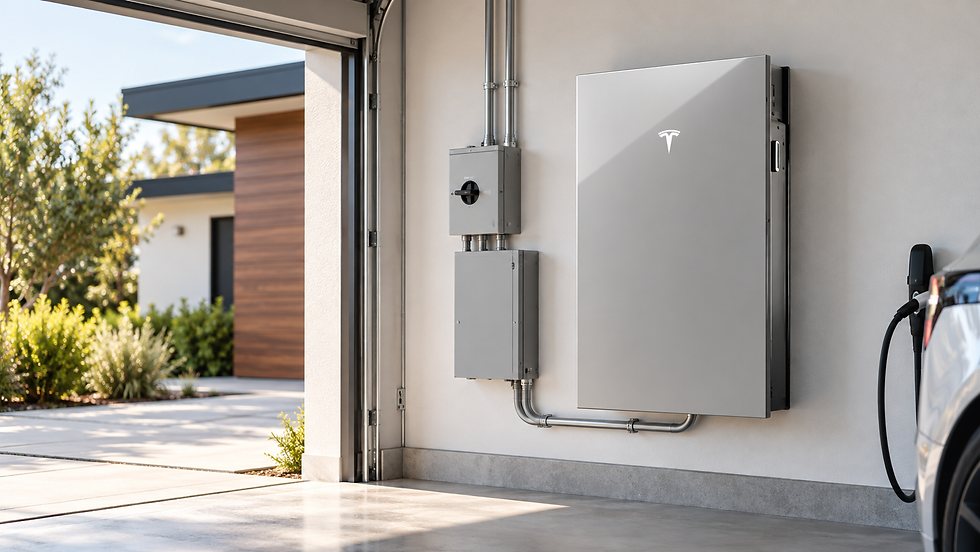
Enter the Tesla Powerwall. Far more than just an emergency backup box for blackouts, a smart battery transforms how you handle your solar generation, effectively turning low-value exports into retail-value energy.
The Problem: The Solar Mismatch and Shrinking Export Credits
To understand why a battery changes the game, look at a typical household’s energy timeline:
9:00 AM to 3:00 PM: Your solar panels are cranking out peak power. However, your house is mostly empty because everyone is at work or school. Energy demand is low.
5:00 PM to 9:00 PM: Everyone comes home. The oven turns on, the TV fires up, laundry gets done, and central air conditioning works overtime. Meanwhile, the sun is setting, and your solar production drops to zero.
Under modern utility structures (such as Time-of-Use or Net Billing tariffs), utilities heavily penalize this mismatch. They pay you wholesale or near-zero rates (say, 3¢ to 5¢ per kWh) when you export excess solar at noon. Then, they turn around and charge you peak retail rates (say, 25¢ to 45¢ per kWh) when you pull electricity from the grid at 7:00 PM.
You are essentially selling low and buying high.
The Solution: How Powerwall Captures and Reinvests Your Solar
A Tesla Powerwall acts as an intelligent energy manager sitting between your solar array and the utility grid. Instead of letting your midday surplus escape for pennies, the system intercepts and redirects it.
1. Absorbing the Midday Surplus
When your solar panels peak at noon, your home takes what it needs, and instead of letting the remaining electricity bleed onto the grid for a fraction of its worth, the Powerwall swallows it up. Within a few hours, the battery is fully charged using energy that would have otherwise been severely undervalued.
2. Bypassing the Evening Peak
As evening rolls around and utility rates skyrocket into their most expensive "peak" window, your home stops drawing expensive power from the grid. Instead, the Powerwall quietly discharges the clean solar energy it stored earlier that day.
Rather than buying back grid power at full retail price, you are essentially consuming your own free, midday solar production on a delayed time-release.
Smart Software: Tesla’s "Savings Mode"
You don’t have to manually flip switches or guess when electricity prices will shift. Tesla’s software features—specifically Savings Mode—automate this entire cycle using predictive intelligence.
Weather Forecasting: The Powerwall syncs with local weather data. If tomorrow’s forecast calls for heavy clouds or a storm, the system learns to optimize its behavior ahead of time.
Tariff Integration: The app maps your specific utility’s Time-of-Use schedule, knowing precisely when off-peak rates end and expensive peak rates begin.
Energy Arbitrage: By hoarding cheap or free solar during the day and discharging it during peak pricing hours, the battery shields your household from high utility bills without requiring any lifestyle changes on your part.
The Real-World Financial Impact
Let's look at the math simply:
\
Without a battery: You export 10 kWh of midday solar to the grid and receive a 4¢/kWh credit ($0.40 total). That evening, you pull 10 kWh from the grid at a peak rate of 35¢/kWh ($3.50 cost). Net cost for that energy cycle: $3.10.
With a Powerwall: You capture that same 10 kWh of solar in your battery. That evening, you use it to power your home, avoiding the grid entirely. Net cost for that energy cycle: $0.00.
Multiply those daily savings over hundreds of cycles a year, and a battery shifts from being a mere emergency backup device into an active financial asset that accelerates your solar payback period.
Maximizing Your Solar Investment with Morton Solar
As utility companies continue to scale back solar export incentives, the financial argument for self-consumption is stronger than ever. Adding a Tesla Powerwall ensures that every kilowatt-hour your panels produce stays under your control, working to offset your highest utility expenses rather than lining the grid's pockets for pennies.
At Morton Solar, we help homeowners across Southern Indiana, Southern Illinois, and Western Kentucky design solar and storage ecosystems tailored to beat changing utility rate structures.
Want to see how much you can save by upgrading your solar setup with a Powerwall?
Contact Morton Solar today at (812) 402-0900 to schedule your personalized energy review.
Would you like to explore how Time-of-Use rate plans specifically impact solar paybacks in your local utility district?


Comments